What Actually Happens To A Lake Hartwell Dock When The House Sells
August 13, 2026
August 13, 2026
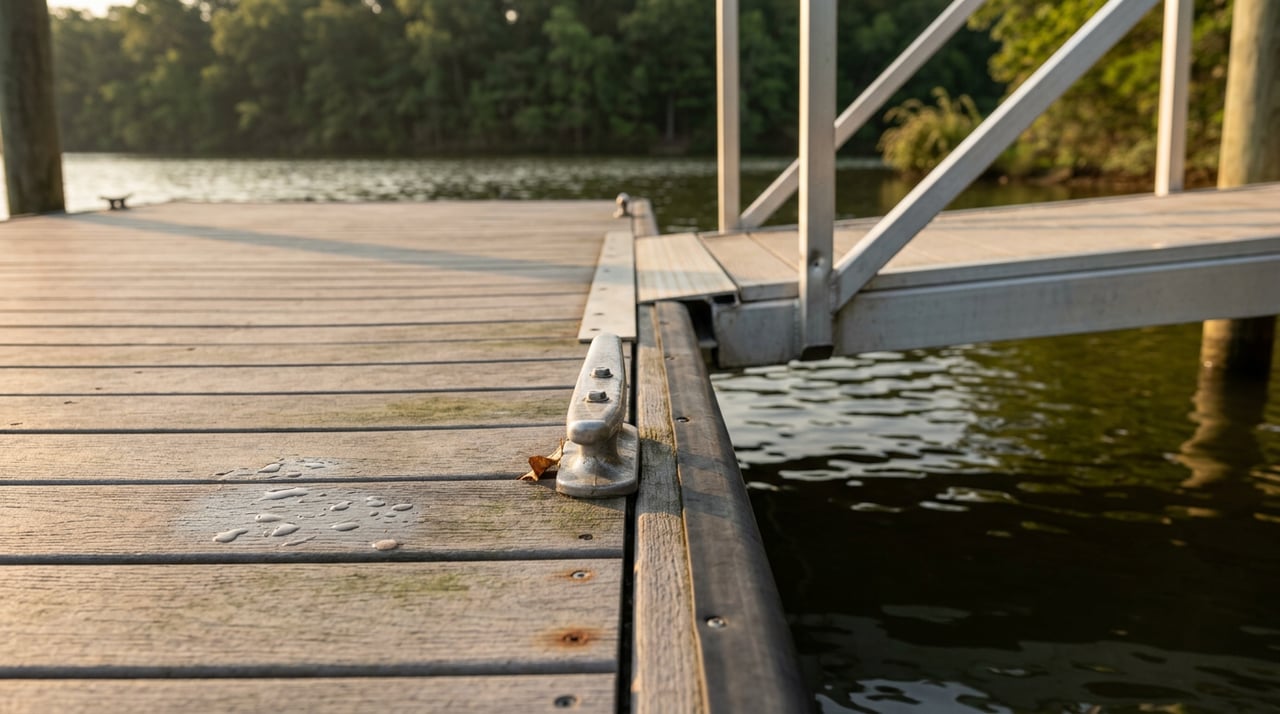
Most buyers assume a permitted dock is like a built-in fireplace or a finished basement: it conveys with the house. On Lake Hartwell, it does not work that way. The dock sitting in the water at your showing is authorized by a document called a Shoreline Use Permit, and the Army Corps of Engineers is explicit that this permit is not a property right. It belongs to the person, not the parcel. The moment title transfers, the seller's permit goes void, and the buyer starts over.
That single mechanical fact changes how you should read a Hartwell waterfront listing. The dock in the photos is real. The legal authorization to keep it there in your name is not automatic, and understanding why tells you more about how to shop this lake than any square footage number ever will.
Hartwell is a federal reservoir. The shoreline you are buying next to belongs to the public, and the Corps' Savannah District manages it under a Shoreline Management Plan that gets revisited roughly every five years, most recently signed in November 2020. A permit is the Corps' way of granting a private citizen temporary, revocable use of public land and public water. If permits transferred automatically at closing, the Corps would lose its ability to check who is actually using its shoreline and whether that use still fits current rules. So the SMP states plainly that new and prospective owners have to apply on their own, and if a property already has a dock authorized under a previous owner's permit, the buyer is required to contact the Operations Project Manager's Office within 14 days of purchase to apply for a new one. Miss that window, or fail to get the new permit issued, and the existing structure has to come out of the water.
That is the trade you are actually making when you buy a house with a dock on Hartwell. You are not purchasing the dock. You are purchasing a two-week clock and a fairly good chance of approval, assuming the site still qualifies.
Whether that chance is good or bad depends on a map most buyers never ask to see. The Corps allocates every stretch of Hartwell's 962 miles of shoreline into zones, and the zone controls what happens next. Green areas are Limited Development, where new and reissued dock permits are routinely considered. Yellow is Protected Shoreline, where some private facilities may already exist but no new boat dock permits get authorized. Red is designated Public Recreation, where private facilities are not allowed at all.
A dock sitting in the water today does not tell you which color it sits in. A house on a yellow segment can still have a grandfathered dock from decades ago, and that existing structure may be reissued to a new owner in the ordinary course, or it may not, depending on how and when it was originally authorized. This is exactly the kind of detail that only shows up when someone calls the Hartwell Project Office and requests a field inspection before writing an offer, which the Corps itself recommends prospective buyers do.
There is a smaller, stricter category worth knowing about if you are looking at an older Hartwell property. Under the SMP, some docks were grandfathered onto shoreline that would not qualify for a permit under today's allocation rules. Those docks can stay in place, but only for as long as the original permittee, or their spouse, continues to own the property. The 2020 Shoreline Management Plan states that this category of dock "must be removed from Hartwell Lake upon the transfer of property ownership," with no path to reissuance for the next owner. In other words, some docks that look permanently permitted are actually less transferable than the standard five-year Shoreline Use Permit, not more. A seller telling you "the dock is permitted, it's fine" may be describing something that cannot legally follow the sale at all.
Once you clear the reissuance hurdle, the physical rules that apply to your new permit are worth checking against what is actually built. The Corps' size and configuration standards have not moved in recent years, and they set a hard ceiling on what a newly built dock, or one being modified or relocated, can be.
| Requirement | Standard |
|---|---|
| Maximum dock size | 1,120 square feet |
| Maximum length or width | 40 feet |
| Minimum lot frontage for a private dock | 75 feet of shared boundary |
| Minimum water depth at the gangwalk connection | Custom Dock Systems lists 4 feet at normal pool. |
| Routine approval timeline | About 30 to 90 days |
An existing dock that predates the current size caps is typically honored as-is even if it exceeds today's limits, but any modification or relocation has to meet current standards. That matters if a seller has quietly extended a walkway or added a second story to a slip dock over the years without updating the paperwork. Ask for the permit number and compare it to what is physically in the water before you assume the two match.
This year adds a real-world complication to all of it. Gauge readings in early August 2026 put Lake Hartwell at roughly 7.6 to 7.8 feet below full pool, and the Corps' own park rangers were warning boaters about exposed hazards back in May, when officials cited a roughly 30-inch rainfall deficit for the upper Savannah River basin dating back to January 2025. The U.S. Drought Monitor has continued to show abnormally dry to minor drought conditions in the area through early August.
Low water changes what a dock is legally allowed to do without changing what it looks like. Owners are permitted to "chase the water," temporarily repositioning a floating dock to keep it afloat as the lake drops, as long as it does not block access to a neighbor's dock or a cove. Sandy Campbell, natural resources manager at Hartwell Lake, has explained that solar-powered docks avoid one of the headaches this creates, since solar service "eliminates inconveniences for dock owners needing to 'chase water'" as reservoir levels drop. Once the lake comes back up, the owner is responsible for moving the structure back to its actual permitted location and pulling any temporary anchor pins.
That means a dock you see on a showing this month may be sitting somewhere other than where its permit says it belongs. It is not a red flag by itself. It is a reason to ask directly where the permitted footprint is, rather than assuming the current position is the legal one.
A short list worth working through with the seller or their agent, ideally before you waive any contingencies:
Can I use the existing dock while my new permit is pending? The permit becomes void at transfer, so the safest approach is to have your reissuance application in progress before or immediately at closing, and to treat the 14-day window as a hard deadline rather than a suggestion.
What if the Corps denies my application even though the seller's permit was current? This has happened to buyers who assumed a verbal go-ahead was final. Get any confirmation of eligibility from the Hartwell Project Office in writing, and consider a permit contingency in your purchase contract if the site's status is not already confirmed.
Does this apply to community docks in an HOA subdivision, not just individual lots? Community and joint-use docks are handled under their own permit categories, so review the subdivision's recorded covenants alongside the Corps paperwork rather than assuming an individual dock's rules apply.
A Hartwell property with water access is still one of the better arguments for living on this lake instead of just visiting it. Knowing which paperwork actually survives the sale, and which does not, is what keeps that argument from turning into a surprise six weeks after closing. If you are looking at a specific dock on a specific cove and want a straight answer before you write an offer, Daniel Sanders & Co. can help you get one.
This article is general information, not legal, tax or financial advice. Consult a qualified professional about your situation.
Stay up to date on the latest real estate trends.

Cozy Reading Space and Library Design Tips for Homes in Clemson.

Designing a Media Room Built for Great Movie Nights in Clemson.

Here at Daniel Sanders & Co., Keller Williams Clemson we understand how important buying or selling a home is. It is not just a transaction, but a life changing event. That is why we strive to provide the most professional and personal touch to every transaction we handle.